
Thoroughbred Horse Breed Guide: Speed, Sensitivity and Care
Reviewed by Dr. Khurrum Shahzad Khosa, DVM
The Thoroughbred is the fastest horse breed in existence, the dominant force in flat racing worldwide, and one of the most influential breeds in the development of modern sport horses. It is also a breed that is consistently misunderstood: labelled difficult, unpredictable, and unsuitable for non-professional riders in ways that misrepresent the breed and do real harm to the horses themselves. Understanding the Thoroughbred — its origins, its physiological profile, its genuine challenges, and its extraordinary qualities — is the starting point for anyone who owns, rides, or cares for one.
Origins and Foundation Sires
Every Thoroughbred alive today traces, through the male line, to one of three stallions imported to England in the late 17th and early 18th centuries. The Byerley Turk, captured at the Battle of Buda in 1686, was the first to arrive. The Darley Arabian, purchased in Syria in 1704, became the most influential of the three — Eclipse, arguably the greatest racehorse of the 18th century, was his great-great-grandson. The Godolphin Arabian arrived in England in the 1720s and completed the foundation. These three stallions, bred to native English mares — themselves selected for speed through generations of informal racing — produced the distinct breed that became the Thoroughbred.
The General Stud Book, first published in 1791, formalised the breed registry and closed the studbook — meaning only horses with documented pedigree tracing to approved foundation stock could be registered as Thoroughbreds. This closure created the genetic consistency and performance specialisation that defines the breed. Racing was both the driver and the test of Thoroughbred breeding for over three centuries, producing an animal that is a supreme specialist in one thing: running as fast as possible over distances of five furlongs to two and a half miles.
Breed Characteristics
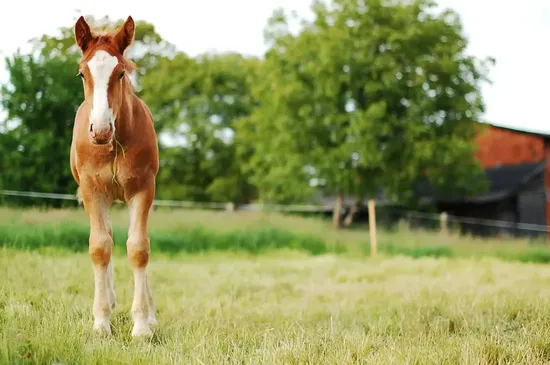
The Thoroughbred is a lean, athletic horse, typically standing between 15.2 and 17 hands, though most racehorses cluster between 16 and 16.2hh. The overall impression is of refinement and athleticism — long legs, a deep chest allowing exceptional lung capacity, a long neck set on oblique shoulders for ground-covering stride, and hindquarters built for explosive power generation. The skin is notably thin, the coat fine, and veining is clearly visible through the skin during and after exercise — evidence of the efficient cardiovascular system underneath.
This fine-coated refinement means Thoroughbreds feel cold more acutely than heavier-coated breeds. They lose body heat more rapidly in wet and cold conditions and typically need rugging earlier in the season and heavier rugs in winter than, say, a native pony would require. This is not weakness — it is a physiological characteristic of a breed built for speed and power efficiency rather than cold-weather survival.
Hoof quality varies significantly within the breed. Thin soles and poor hoof wall quality are not uncommon in Thoroughbreds, particularly ex-racehorses that have spent years on synthetic or traditional racing surfaces and had their hooves managed for racing rather than ridden work. Barefoot or booted transitioning may be needed for some OTTBs as the hoof adapts to different work demands.
Temperament
The Thoroughbred is classified as hot-blooded — meaning sensitive, reactive, and energy-dense. The label is frequently used as shorthand for "difficult", which is both inaccurate and unfair to the breed. Thoroughbreds are reactive because they are sensitive; they are sensitive because their entire evolutionary and selective breeding history has emphasised a lightning-fast response to stimuli. A racehorse that waits to process information before responding loses races. That same responsiveness in a riding horse reads as alert, forward, and engaged — qualities that most experienced riders appreciate.
What creates genuinely difficult behaviour in Thoroughbreds is almost always one of three things: undiagnosed pain (gastric ulcers and hoof discomfort are the most common culprits), management that fails to meet the horse's needs (insufficient turnout, inadequate social contact, excess starch in the diet), or a training history involving coercive methods that have created fear associations. Address those three factors and the vast majority of Thoroughbreds that are described as difficult become manageable, and many become genuinely easy.
Thoroughbreds that are treated well — with ample turnout, social contact, forage-based feeding, and patient handling — are typically intelligent, willing, and affectionate horses. They have a quality of engagement with humans that their sensitivity enables: they read their handlers closely and respond to nuance in a way that heavier-bodied breeds sometimes do not. This makes them rewarding for experienced riders and challenging for those who cannot yet read equine communication clearly.
Life After Racing: The OTTB
The off-the-track Thoroughbred (OTTB) has become a major part of the horse world outside racing, as thousands of horses retire from racing each year and enter the wider equestrian population. OTTB rehoming charities and retraining programmes in the UK, Ireland, US, and Australia have done extraordinary work increasing the success rate of these transitions.
Many OTTBs arrive in a behavioural state that their new owners find confusing: they may appear oddly dull and flat, seemingly uninterested in their environment, docile in a hollow, mechanical way. This is sometimes called the "shutdown" state — a psychological response to the rigid, high-stimulus environment of a racing yard where the horse learned that individual expression, curiosity, and spontaneous movement were not useful strategies. As turnout, social contact, and lower-pressure management begin to take effect over weeks and months, the horse's real personality emerges. This emergence can include energy and reactivity that surprises owners who experienced the initial flatness — but it is a sign of psychological recovery, not deterioration.
Physically, OTTBs often need time to build topline, adjust to different nutrition, and address any subclinical lameness or gastric ulcer issues that accumulated during their racing career. A thorough veterinary assessment on arrival — including gastroscopy if gastric ulcer symptoms are present — is a worthwhile investment that prevents management problems later.
Key Health Challenges
Gastric ulcers are extraordinarily prevalent in Thoroughbreds. Racing management — infrequent forage access, high-starch concentrate feeds, stress, intense exercise, and NSAID use — creates near-perfect conditions for ulcer development. Prevalence in active racehorses consistently exceeds 80% in endoscopic studies. Behavioural signs include irritability when girthed, reluctance to work, reduced appetite, poor condition, and changes in temperament. Treatment with omeprazole is effective; management changes to prevent recurrence are equally important.
Exercise-induced pulmonary haemorrhage (EIPH) — bleeding from pulmonary vessels during maximal exertion — affects the majority of racehorses to some degree. Severe cases produce visible nosebleeds; milder cases are only detectable on endoscopy. EIPH is less commonly a management issue in Thoroughbreds after racing, as the exercise intensities required to trigger it in the field are rarely reached.
Osteochondritis dissecans (OCD) is a developmental joint condition that occurs in young Thoroughbreds when joint cartilage fails to ossify normally, producing cartilage flaps or cysts within joints. It is associated with rapid early growth, nutrition, and genetics. Surgical treatment is available for affected joints.
Suspensory and tendon injuries are the leading cause of career-ending lameness in racehorses. The extreme forces generated at racing speeds stress soft tissue structures near their biological limits. OTTBs that come from racing may have histories of tendon or ligament injury that require careful management assessment before returning to work.
Feeding and Nutrition
Thoroughbreds are hard keepers — they tend to metabolise efficiently for speed but can lose condition quickly under physical or psychological stress, in cold weather, or when recovering from health challenges. The dietary priority for most Thoroughbreds is fibre-first: high-quality hay or haylage as the dietary foundation, fed in a way that maintains near-continuous intake and minimises the gaps in forage availability that drive gastric acid accumulation and ulcer risk.
Calorie addition for horses that need condition is best achieved through high-fat, high-fibre supplementation — oil, sugar beet, fibre-based compound feeds — rather than large starchy concentrate meals, which elevate ulcer risk and can increase reactivity and excitability. This is a common mistake with Thoroughbreds that are described as "needing more energy" but are actually receiving energy in a form that worsens their health and behaviour.
Disciplines After Racing
Thoroughbreds compete successfully across virtually all ridden disciplines. In eventing, the Thoroughbred's natural courage, athleticism, and speed make it a logical choice — many of the sport's most celebrated horses have been Thoroughbreds or near-Thoroughbreds. In dressage, their sensitivity and work ethic translate well with patient training. In showjumping, their scope and athleticism are clear assets. Hacking, pleasure riding, and amateur competition across all levels are equally valid destinations for well-managed ex-racehorses. Para-equestrian sport has also found OTTBs to be excellent candidates for retraining.
Explore our full horse breed guide collection for more on choosing and caring for horses across all disciplines.
Frequently Asked Questions
Are ex-racehorses good riding horses?
Yes — with appropriate time, support, and patient retraining, OTTBs make excellent riding horses across many disciplines. The transition takes time: expect weeks to months of decompression before serious ridden work begins. Many OTTBs that are well managed become genuinely easy, willing partners.
Why do Thoroughbreds get gastric ulcers?
Racing management creates near-perfect conditions for ulcer development: infrequent forage access, high-starch feeds, stress, intense exercise, and NSAID use. Ulcers are extremely common in Thoroughbreds. A forage-first approach to feeding and management changes that reduce stress dramatically lower ulcer risk.
What is EIPH in horses?
Exercise-induced pulmonary haemorrhage is rupture of lung blood vessels during maximal exertion, causing blood to appear in the airways. It is very common in racehorses. Mild cases are only detected on endoscopy; severe cases produce visible nosebleeds. It is less of an ongoing management issue once a horse leaves racing.
How do you retrain a Thoroughbred off the track?
Start with decompression time — turnout, social contact, good nutrition — before ridden work. Then retrain from the ground up: teach balance, rhythm, and transitions at walk and trot before progressing. Positive reinforcement approaches work very well. Common early challenges (difficulty standing still, pulling on the rein) resolve with consistent patient work.
How much does a Thoroughbred eat?
Thoroughbreds are typically hard keepers with fast metabolisms. High-quality forage should be the dietary base, with additional calories from high-fat, high-fibre sources rather than large starch meals. Individual horses vary widely but many need significantly more calories than heavier-bodied horses of equivalent size.
Disclaimer: This article is for educational purposes only and does not constitute veterinary advice. Always consult a licensed equine veterinarian for diagnosis and treatment.

About the Author
Mike Albert Pet Care Advocate & Equine Wellness WriterMike is a passionate advocate for the welfare of horses, birds, and fish. With a background in animal husbandry and equine management, he brings firsthand experience to every guide he writes, helping owners provide the best possible care for a wide range of pets.

✓ Veterinary Reviewed
Dr. Ali Ehtisham, DVM Equine & Large Animals Rood & Riddle Equine Hospital — USADr. Ali Ehtisham is a Pakistani-trained equine veterinarian with experience at Rood & Riddle Equine Hospital. He specialises in horse health, performance, and preventive equine care.
LinkedIn ProfileReviewed for medical accuracy — not a substitute for professional veterinary advice. Learn about our review process.