
How to Keep Cats Off the Bed: Methods That Work
Reviewed by Dr. Ameer Hamza, DVM
If you have ever woken up at 3 a.m. to a cat sitting on your face or discovered your pristine duvet covered in fur before you have even climbed into it, you already understand the challenge. Cats are drawn to human beds with remarkable stubbornness, and simply shooing them off tends to work for about thirty seconds. The good news is that with the right combination of methods — applied consistently and sympathetically — it is entirely possible to keep a cat off the bed without drama, without damaging your bond, and without resorting to anything that would cause your cat stress or confusion.
Why Do Cats Love Sleeping on Your Bed?
Before trying to change a behaviour it helps to understand why it exists in the first place. Your bed is, from your cat's perspective, one of the most desirable locations in the entire home, and this is not an accident. The most significant draw is warmth. Cats have a higher preferred body temperature than humans — around 38.5°C — and are constantly seeking out warm environments. Your mattress and bedding retain significant body heat both during the night and for hours afterward, making your bed thermally irresistible in a way that a cold tile floor or even a room-temperature cat bed simply cannot match.
Scent plays an equally powerful role. Cats rely on smell as their primary means of assessing safety and familiarity. Your bed is saturated with your personal scent — a smell the cat has strongly associated with security, comfort, and companionship since it first bonded with you. Sleeping in a space that smells of you is, for a cat, the olfactory equivalent of sleeping next to you. This is also why cats often seek out the bed most urgently when their owner is away or when the household routine has been disrupted — they are seeking olfactory reassurance.
There is also a social dimension. Cats are sometimes characterised as solitary animals, but domestic cats — particularly those that have been socialised well with humans — do form genuine social bonds. Sleeping together is a behaviour seen between bonded cats in multi-cat households and serves as a form of social affiliation. Your cat choosing to sleep on your bed is, in many ways, a compliment. It means your cat trusts you completely and considers you part of its social group. Understanding this helps you approach the process of changing the habit with empathy rather than frustration.
Why You Might Want to Change This Habit
Despite the touching reasons behind it, there are entirely valid reasons to keep a cat off the bed. Allergies are among the most common. Cat dander — the microscopic particles shed from skin and fur — accumulates rapidly in soft bedding, and sleeping in close proximity to this accumulation for eight hours a night can significantly worsen allergic symptoms including nasal congestion, itchy eyes, and asthma attacks. Even people with only mild cat allergies during the day often find their symptoms are worst in the morning after a night of sleeping with the cat, and the bedroom is frequently identified as the single most beneficial space to make allergen-free.
Sleep disruption is another frequently cited reason. Cats are crepuscular animals — biologically active at dawn and dusk — which means their most energetic periods often coincide with the hours just before and just after your intended sleep. A cat sharing your bed may groom noisily, knead insistently, jump on and off repeatedly throughout the night, or simply reposition itself in ways that disturb your sleep without fully waking you. This kind of fragmented sleep accumulates as sleep debt over time and has measurable effects on cognitive performance, mood, and physical health.
Hygiene is a third consideration, particularly for owners who allow outdoor access. An outdoor cat that comes in at night and goes straight to the bed brings with it whatever it has encountered outside — mud, pollen, pesticides, and potentially parasites such as fleas or ticks. Even indoor cats can carry litter granules to bed. None of these concerns mean you cannot have a warm, loving relationship with your cat; they simply mean that the bed itself may not be the best place to express that relationship.
8 Methods That Actually Work
The most important thing to understand before you begin is that no single method is a magic solution, and success almost always requires combining several approaches and applying them consistently over a period of weeks. Cats are creatures of habit, and the older and more entrenched the habit, the longer the adjustment period. Here are eight methods that have genuine effectiveness when applied properly.
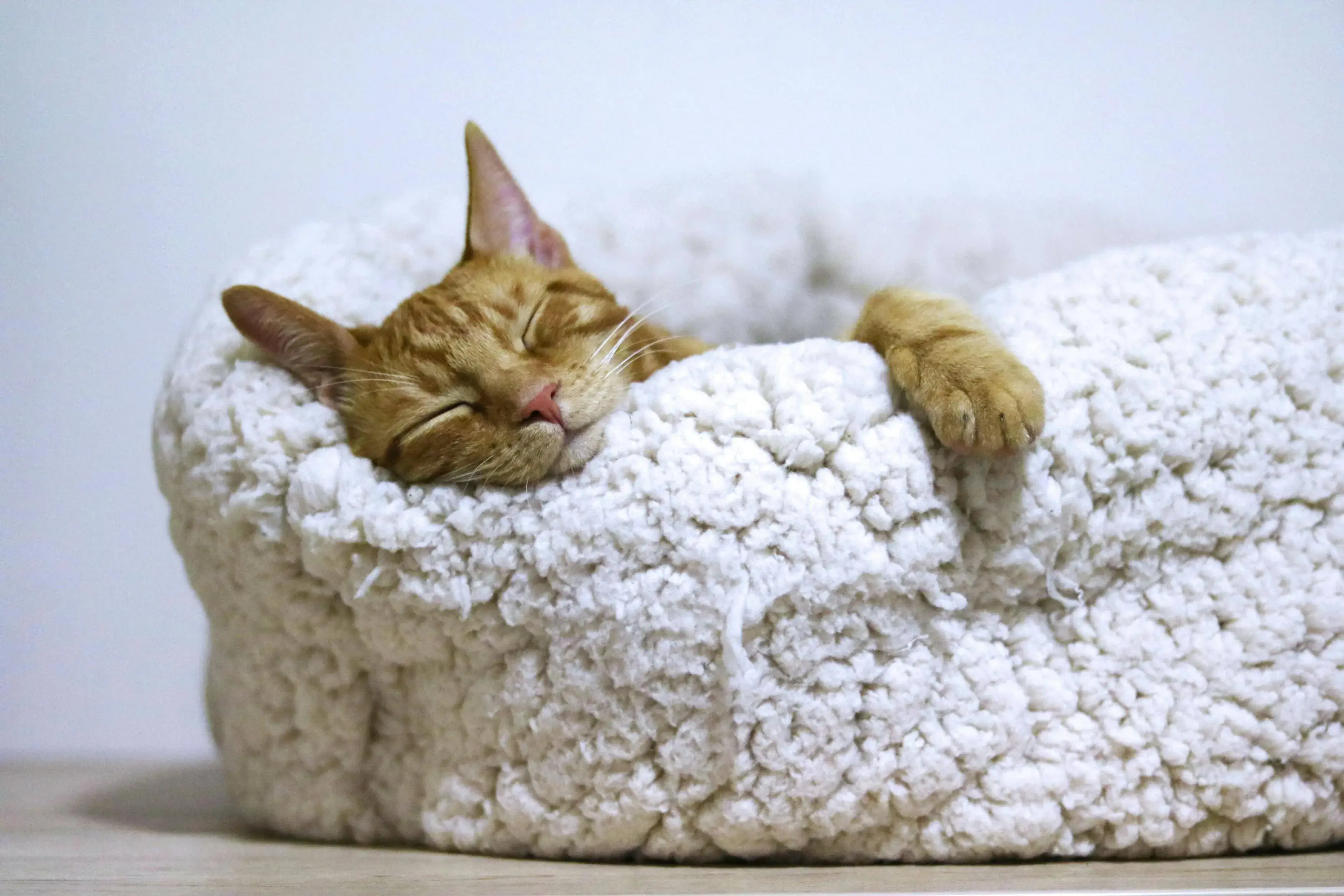
1. Provide a comfortable cat bed alternative. This is the foundation of any successful strategy and the step most owners skip — or underfund. If you want your cat to sleep somewhere other than your bed, you need to provide an alternative that is genuinely appealing, not merely adequate. A thin flat mat on a cold floor will not compete with your warm, soft, scented mattress. Instead, invest in a self-warming or heated cat bed with plush, enclosed walls — a donut-style or cave-style bed that retains body heat and creates a sense of enclosed security. The critical detail that dramatically increases the likelihood of acceptance is scent: place a worn t-shirt or pillowcase inside the bed before introducing it to your cat. This immediately makes the new bed smell familiar and safe, significantly lowering the cat's resistance to using it.
2. Use strategic placement. The location of the cat bed matters as much as the bed itself. Many owners make the mistake of placing the new bed in a room the cat rarely visits or in a low corner when the cat prefers elevated positions. Observe where your cat already rests during the day and place the bed there, or very close to it. If your cat gravitates toward height, position the bed on a shelf, a cat tree platform, or a window perch. If your cat likes proximity to you during sleep, placing the bed just beside your bed — or just outside the bedroom door — is a reasonable intermediate step that honours the cat's need for closeness without allowing it onto the mattress. Proximity eases the transition considerably and gives you a platform to gradually move the bed further away as the new habit becomes established.
3. Apply consistent reinforcement across all household members. Inconsistency is the single most common reason cat training fails. If you enforce the no-bed rule but your partner allows the cat up when you are not watching, the cat receives conflicting signals and will default to the behaviour that sometimes produces the reward (being on the bed with a human). Every person in the household needs to apply the same rules, every time, without exception. When the cat uses its own bed, offer calm, quiet praise or a small treat — calm is important because overexcited responses can startle some cats and undo the positive association. When the cat jumps onto the human bed, calmly and gently place it back in its own bed without scolding, dramatic reactions, or prolonged interaction that could inadvertently reward the behaviour with attention.
4. Use deterrent mats on the bed surface. Plastic deterrent mats — also sometimes called scat mats — have a textured surface that cats find deeply unpleasant to walk on and will actively avoid. Covering your bed with these mats during the day when you are not using it teaches the cat, over time, that the bed is not a welcoming surface. The limitation of this method is that you will remove the mats to sleep, at which point the cat is free to return, so it is most effective as a daytime measure. It works best in combination with providing a highly attractive alternative: the cat encounters an unpleasant surface on the bed and simultaneously has a warm, comfortable cat bed available, and over time the cat bed becomes the default choice. Avoid any mats or devices that deliver an electric shock or sudden startle — these can create fear and anxiety that damages your relationship with the cat and can cause lasting behavioural problems.
5. Use the closed-door approach. For overnight exclusion, the simplest and most reliable method is to keep the bedroom door closed. There is no ambiguity for the cat and no opportunity for the habit to continue. The initial period of adjustment will involve protest — expect vocalisation outside the door, scratching, and attempts to push the door open. This phase is normal and almost universal, and the most important thing you can do is resist opening the door in response to the noise. Responding to vocalisation by opening the door teaches the cat an extraordinarily powerful lesson: making noise gets the door opened. Instead, wait for a moment of silence before going to check on the cat, so that quiet behaviour — rather than noise — is what precedes the door opening. Most cats reduce their protest behaviour significantly within one to two weeks when the response is consistently unrewarding.
6. Time the change strategically. The timing of when you begin the transition matters more than most owners realise. Starting the change during a high-stress period in your own life — when you are exhausted, overwhelmed, or emotionally stretched — sets you up to give in at the first sign of protest, which resets the cat's expectations and makes the next attempt harder. Begin during a calm period when you have the patience and energy to remain consistent for at least two to three weeks. Crucially, increase your cat's physical activity and mental stimulation during this period: longer play sessions before bedtime using wand toys or puzzle feeders tire the cat out and reduce the energy available for nocturnal bed-seeking. A cat that has hunted, chased, and eaten — mimicking the natural hunt-catch-eat-groom-sleep cycle — is far more likely to settle contentedly in its own space than one that has been sedentary all day.
7. Apply scent deterrents. Cats have an extraordinarily sensitive olfactory system and will avoid areas associated with scents they find aversive. Citrus is the most widely used natural deterrent — cats generally dislike the smell of lemon, orange, and grapefruit. Lightly spraying the bed frame or the area around the bed with a diluted citrus spray, or placing dried citrus peel near the bed, can reduce the cat's inclination to approach. Commercial cat-repellent sprays are also available and use various scent compounds with similar deterrent effects. Always check that any product used around your cat is non-toxic and safe for feline contact — essential oils in concentrated form can be harmful, so dilution and careful product selection are essential. Scent deterrents work best as one part of a broader strategy rather than the sole method, as their effectiveness diminishes if the cat is highly motivated to access the bed for warmth or social reasons.
8. Positively reinforce the cat bed. This final method ties all the others together. Rather than simply making the human bed less accessible, invest equal energy in making the cat bed more desirable. Feed treats in or near the cat bed regularly. End interactive play sessions near the cat bed so the cat's post-play relaxation response is associated with that location. Place the cat bed near a heat source such as a radiator, underfloor heating vent, or a sunny window, since warmth is one of the primary reasons the human bed was attractive in the first place. Use catnip spray on the bed surface for cats that are responsive to catnip — it creates a strong positive association with the space. Over a period of weeks, the goal is for the cat bed to become the cat's first-choice resting location, not a compromise forced on it, but a genuinely preferred destination that meets all of its comfort and security needs.
What Not to Do
There are a number of approaches that owners try out of frustration that are counterproductive and worth actively avoiding. Shouting at or physically startling the cat when it jumps on the bed is ineffective because the cat does not reliably associate the punishment with the act of being on the bed — it associates it with your presence, which can make the cat fearful or anxious around you without actually reducing the bed-seeking behaviour. Squirting the cat with water is a similarly popular but misguided method; it often creates fear of the owner rather than of the bed, and the cat simply learns to avoid the behaviour when you are present while continuing it when you are not.
Inconsistency is arguably the most damaging behaviour of all. Allowing the cat onto the bed when you are ill or lonely, or letting it stay because it seems sad, immediately undoes days or weeks of progress and teaches the cat that persistence eventually works. Cats are highly sensitive to intermittent reinforcement — in fact, a behaviour that is rewarded only sometimes is often more persistent than one that is rewarded every time, because the cat keeps trying in the hope that this time will be the rewarding one. If you are going to make the change, commit to it fully and do not make exceptions during the adjustment period.
How Long Does It Take?
The honest answer is that it depends heavily on how long the habit has been established, the individual cat's personality, and how consistently the new approach is applied. For a young cat that has only recently started using the bed, the transition can happen within a week or two of consistent application. For a cat that has slept on the bed for several years, expect a more protracted adjustment — typically three to six weeks before the new sleeping pattern is reliably established, and possibly longer before the cat stops attempting the occasional bed visit entirely.
Highly social and bonded cats typically take longer to adjust than more independent ones, not because they are more stubborn, but because the emotional need driving the behaviour — the desire for closeness to their person — is stronger. In these cases, ensuring the cat bed is positioned very close to you (beside the bed, at the same height if possible) and that you continue to provide abundant daytime affection and play will support the adjustment significantly. The transition is almost always achievable with patience; the cats that never adjust are typically those living in households where the rules are applied inconsistently or abandoned too soon.
Frequently Asked Questions
Is it bad to let your cat sleep in your bed?
Letting your cat sleep in your bed is not inherently harmful to either party, and many owners find it a source of comfort and bonding. However, there are genuine reasons some owners choose to change the arrangement. People with cat allergies, asthma, or compromised immune systems should avoid sharing sleeping space with their cat, as dander accumulation on bedding can significantly worsen symptoms overnight. Light sleepers may also find that a cat's nighttime activity — jumping on and off the bed, grooming loudly, or kneading — leads to fragmented and unrestorative sleep, which has real consequences for daily functioning and long-term health.
Why does my cat only want to sleep on my bed and nowhere else?
Cats are drawn to your bed for a combination of warmth, comfort, and scent. Your body heat warms the mattress and bedding during the night, and the lingering warmth during the day makes it one of the most thermally appealing spots in the entire home. Equally important is scent — your bed is saturated with your personal odour, and for a cat that is bonded to you, that smell is deeply reassuring and associated with safety. If the cat has slept on your bed since kittenhood, it has also simply learned this is where comfortable, secure sleep happens, and breaking a well-established routine always takes more persistence than preventing one from forming in the first place.
Do cat deterrent mats work?
Cat deterrent mats can be an effective part of a broader strategy, but they rarely work as a standalone solution. These textured plastic mats have a surface that cats find unpleasant to walk on, discouraging them from settling on the covered surface. The limitation is that the moment you remove the mat — for example, when you go to bed yourself — the cat is free to return, so the deterrent only works when you are not using the bed. They are most useful during the daytime or when you want to prevent the cat from accessing the bed while you are away. For overnight deterrence, combining a mat strategy with a closed-door approach or a highly attractive alternative sleeping spot is far more effective.
Will my cat be unhappy if I stop letting it sleep with me?
Cats are adaptable animals and the vast majority adjust to a new sleeping arrangement without lasting distress, provided the transition is handled thoughtfully. The key is ensuring the cat has a warm, comfortable, and secure alternative sleeping location that meets its natural preferences — a raised or enclosed bed placed in a quiet area where it already likes to rest will be accepted far more readily than a flat mat on the floor in a strange corner. Expect a period of protest, particularly if the habit is long-established: vocalisation outside the bedroom door and attempts to scratch or push through are normal and typically diminish within one to three weeks if you remain consistent. Continuing to engage your cat with play, affection, and quality interaction during the day helps reassure it that the relationship is intact even if the sleeping arrangement has changed.
What is the best type of cat bed to encourage cats off the human bed?
The best cat bed to use as an alternative to yours is one that replicates the features your cat values most about sleeping with you — warmth, softness, security, and your scent. A self-warming or heated cat bed with plush interior walls (a donut or cave-style bed) tends to be highly appealing to cats because it holds body heat and creates a sense of enclosed, safe space that mirrors the security cats seek. Placing a worn item of your clothing — a t-shirt or pillowcase — inside the bed transfers your scent and dramatically increases the likelihood of acceptance. Position the bed at an elevated height if your cat typically prefers to sleep up high, as location matters as much as the bed itself. Avoid cheap, thin flat mats as a first offering, since they offer none of the warmth retention or security that makes your bed so attractive in the first place.
For more ideas on keeping your cat engaged, comfortable, and fulfilled at home, see our guide to indoor cat enrichment ideas and our article on how to keep an indoor cat happy. Both resources pair well with the behaviour guidance above and will help you give your cat a home environment it thrives in — with or without access to your bed.
Disclaimer: This article is for educational purposes only. Always consult a licensed veterinarian for your pet's health and medical needs.
For a full overview of cat health, nutrition, behaviour, and care, see the complete cat care guide.

About the Author
Reena Scot Pet Care Expert & Certified Feline SpecialistReena has over a decade of experience in feline health, behaviour, and nutrition. She has worked with animal shelters, veterinary clinics, and cat adoption programmes, helping owners make informed decisions about care, diet, and long-term wellness for their cats.

✓ Veterinary Reviewed
Dr. Ameer Hamza, DVM Companion Animals (Cats, Dogs, Birds, Fish) Manj Pets & Veterinary Clinic — Lahore, PakistanDr. Ameer Hamza is a Lahore-based veterinarian practising at Manj Pets & Veterinary Clinic. He specialises in companion animal care including preventive health, nutrition, and clinical treatment for cats and dogs.
LinkedIn ProfileReviewed for medical accuracy — not a substitute for professional veterinary advice. Learn about our review process.